Some Assembly Required: Part I
Part I: The Declaration, the Constitution, and an Unfinished Democracy
"The Declaration of Independence is our mission statement. The Constitution is our user's guide."
— Jon Meacham
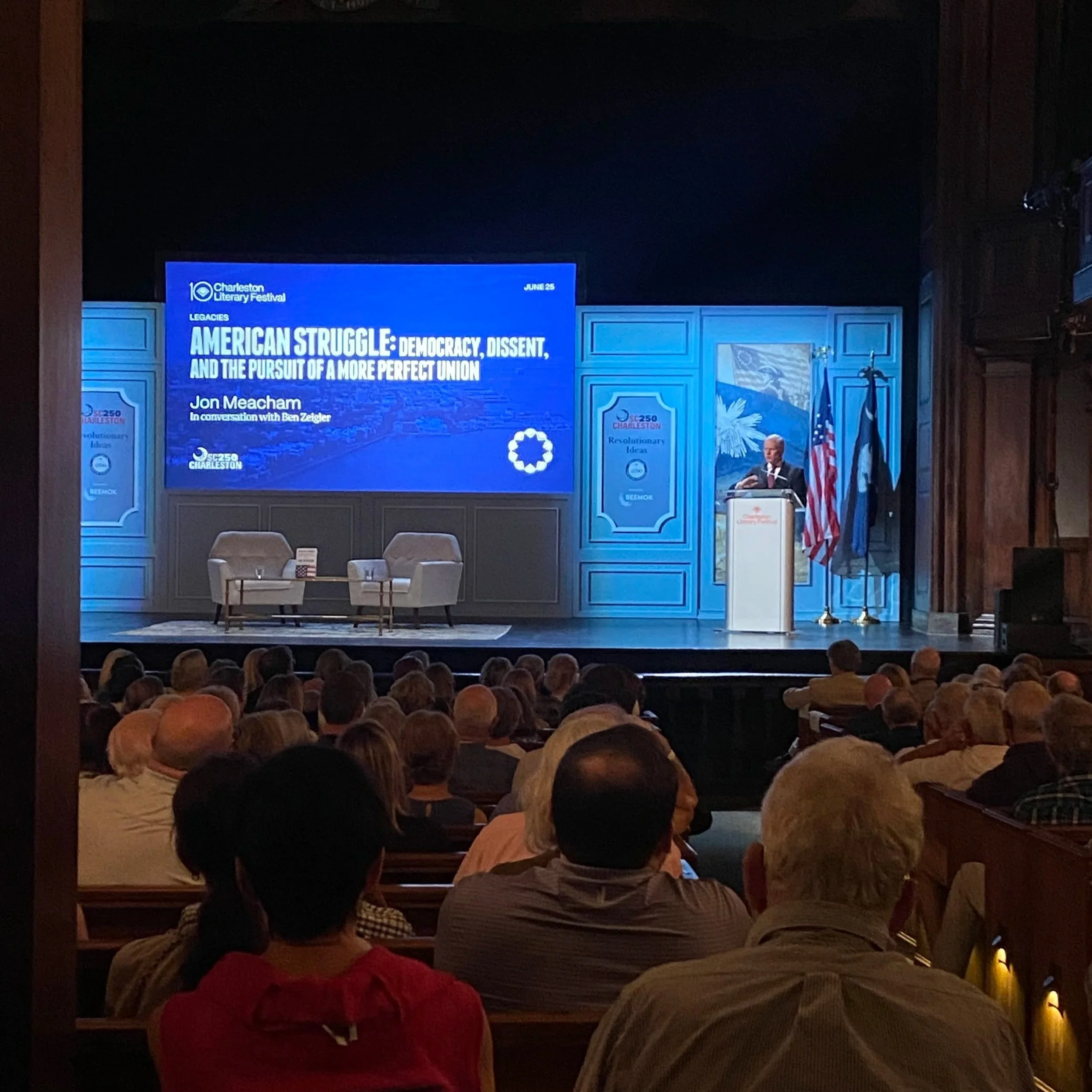
Earlier this year, I had the privilege of hearing historian and Pulitzer Prize-winning author Jon Meacham speak during the Faith & Politics Institute Pilgrimage. He said a lot that stayed with me, but it wasn't until I heard him speak again last month in Charleston…this time alongside my dad and my uncle, two fellow history lovers (my dad a historian himself and has long considered Jon Meacham one of his heroes)—that one particular line landed differently.
I immediately pulled out my Notes app before I could lose it.
“The Declaration of Independence is our mission statement. The Constitution is our user’s guide.”
Simple. Clear.
And yet it completely reframed the way I’ve been thinking about American democracy over the past several months.
Meacham often credits this way of thinking to the work and writings of abolitionist Frederick Douglass, who challenged America not to abandon its founding ideals, but to finally live up to them.
The Declaration tells us why.
The Constitution tells us how.
That distinction feels especially important right now.
A mission statement explains why we exist. It points us toward the future we're trying to build and it articulates our values and aspirations. The Declaration of Independence does exactly that. It offers an audacious vision—that all people are created equal and possess inherent dignity, that liberty matters, that governments derive their power from the people, and that equality isn't merely an aspiration but a promise.
The Constitution serves a different purpose. It answers the question: how do we actually do this?
It establishes how power is distributed, how government is held accountable, how laws are made, and how disagreements are resolved. It's the operating manual for one of the world's oldest democratic experiments.
Here’s where it clicked for me:
User’s guides get updated. Not because the mission has changed, but because the world does.
Think about the instruction manual that came with your phone ten years ago. The purpose of the phone hasn't changed—it’s still designed to connect people—but the technology has. The instructions evolved to meet new realities, challenges, and possibilities.
Our democracy is no different.
The founders never intended the Constitution to be a finished document. In fact, they built the amendment process directly into it because they understood something profound: they were creating a framework, not a final draft. They knew they couldn't anticipate every challenge, every injustice, every innovation, or every generation that would come after them.
They weren’t writing the final chapter, they were inviting us to become co-authors of the user’s guide.
For generations, conversations about the Constitution have often treated it as something untouchable—as though the highest form of patriotism is preserving it exactly as it was written in 1787.
But that's not actually what the founders envisioned.
For nearly 250 years, Americans have continued revising the user's guide—not because we rejected the mission, but because we believed the mission was worth pursuing more fully.
We abolished slavery.
We guaranteed equal protection under the law.
We expanded the right to vote beyond white men with property.
We prohibited poll taxes.
We lowered the voting age to eighteen because if young people could be sent to war, they deserved a voice in choosing their leaders.
I could go on.
None of those changes abandoned the founders' vision, they challenged us to live up to it.
That feels like an important distinction in today's political climate. Too often, change is framed as betrayal - as if preserving democracy means preserving every rule exactly as we inherited it.
But updating the user's guide isn't rejecting the mission. It's honoring it.
Every generation inherits both extraordinary progress and unfinished work. Our responsibility isn't simply to preserve democracy exactly as we found it; it’s to leave it more representative, more inclusive, more just, more accessible, and more responsive than it was when it was entrusted to us.
Democracy was never designed to be static; it was designed to be stewarded. Maybe that's why this idea has felt so timely right now.
Over the last several months here in South Carolina, we've watched thousands of ordinary people doing exactly what Meacham's analogy describes. People testified before legislative committees, organized their neighbors, spoke out against mid-decade redistricting, voted in historic numbers, and after years of persistence, helped secure meaningful pro-democracy reforms at the State House.
South Carolina became the only state in the South to hold off mid-decade congressional redistricting ahead of the 2026 election. Voters shattered modern-era primary turnout records. Laws that had been years in the making finally crossed the finish line.
Those victories didn't happen because democracy worked perfectly. They happened because people believed democracy could work better.
In ways both big and small, South Carolinians helped rewrite a few pages of the user's guide—not by changing the mission, but by making our democracy more accessible, more representative, and more responsive.
Maybe that's what gives me hope. Not the belief that we've figured democracy out, but the reminder that ordinary people still believe they can shape it.
And, that raises an even bigger question: If we were writing the next edition of the user’s guide today, what would we change? Tune back in on Friday for Part II of this reflection, where I'll explore what the next edition of our democracy’s user's guide might look like in our own time.
Perhaps what I appreciate most about Meacham's analogy:
A user's guide assumes there will be future users.
People who will encounter problems we couldn't imagine.
People who will ask better questions.
People who will discover better solutions.
People who will continue writing the next chapter.
Maybe that's the greatest act of faith our founders demonstrated—not believing they had all the answers, but believing future generations would keep doing the work.
As we mark America’s 250th anniversary, I'm less interested in asking whether we’ve perfectly lived up to its founding ideals. The answer is clearly no, we haven’t.
I'm more interested in asking whether we're still willing to accept the invitation to keep writing. Whether we're willing to keep improving the user's guide so more people can experience the promise of the mission. Whether we'll choose participation over cynicism, community over isolation, joy over despair, courage over complacency, hope over fear. Whether we'll leave the next generations a democracy that more fully lives up to its own mission statement.
The Declaration gave us the destination.
The Constitution gave us the map.
The rest has always been up to us.
Stay tuned for part 2 of this reflection: “How do we make the user's guide better reflect the mission statement?”